

The Ultimate Guide to the 7 Iconic Bridges in Budapest
Budapest is often called the city of bridges for a good reason. The mighty Danube River splits the capital into two distinct geographical sides. Buda stands on the hilly west bank with its royal history. Pest stretches across the flat eastern plain with its vibrant energy. For centuries, people could only cross the water by boat or ice. Today, seven major historic bridges connect these two halves of the soul. Each structure tells a unique story of war, peace, and engineering. You will find many beautiful bridges in Budapest to admire during your stay.
The Széchenyi Chain Bridge: The First Link
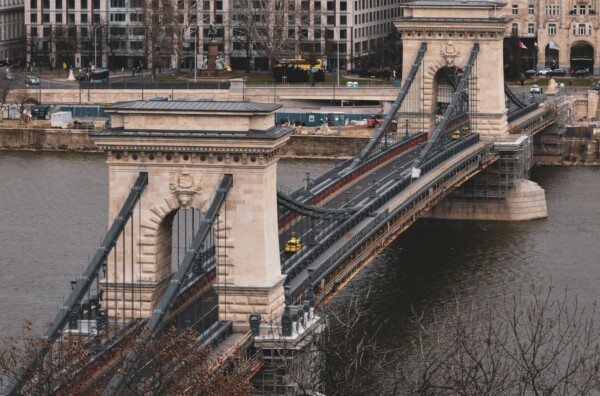
The Chain Bridge is the oldest permanent stone bridge in the city. Before 1849, crossing the river was dangerous and very slow. Count István Széchenyi decided to build a fixed link after a tragedy. He could not attend his father’s funeral because of the drifting ice. He hired an English engineer named William Tierney Clark for the job. An Adam Clark managed the difficult construction process in the city center.
The style of the bridge is classicist and very grand. Two massive stone lions guard each entrance of this famous landmark. There is a famous urban legend about these stone lions. People say the sculptor forgot to carve tongues for the animals. However, this is not true because the tongues are just hidden. You can see them if you look from a high angle.
The bridge was almost totally destroyed during the Second World War. Only the two main towers remained standing after the explosions. It was rebuilt and reopened exactly one hundred years after its birth. Today, it remains the most famous of all bridges in Budapest. It is the heart of every national celebration and firework show.
Location: Between Clark Ádám Square and Széchenyi István Square
Margaret Bridge: The Elegant Y-Shape
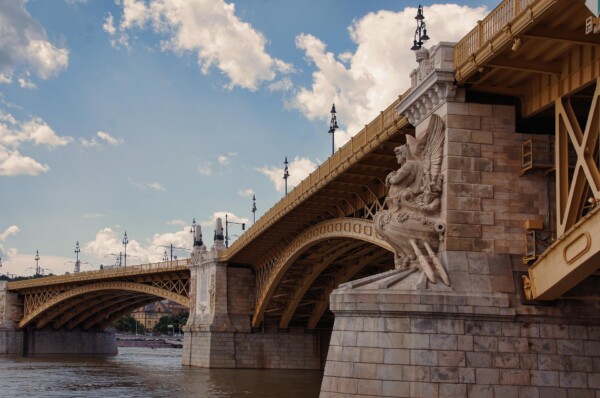
Margaret Bridge is the second oldest bridge in the Hungarian capital. It was designed by a French engineer named Ernest Goüin. The construction took place between 1872 and 1876 with French style. You can see the influence of Paris in its ornate details. The most unique feature is the 165-degree turn in the middle. This turn allows a third wing to reach Margaret Island.
The bridge is decorated with beautiful sculptures of ships and gods. You can see the crown of the Holy Roman Empire too. It offers the most spectacular view of the Hungarian Parliament building. Many professional photographers gather here during the golden hour for photos. It is one of the most practical bridges in Budapest for walkers. You can easily reach the city’s greenest park from the middle.
During the renovation, workers restored the original dragon-shaped lamp posts. The bridge looks like a piece of jewelry at night time. It connects the Grand Boulevard of Pest with the Buda side. You should walk across it to feel the French elegance.
Location: Connects Jászai Mari Square with the Buda embankment
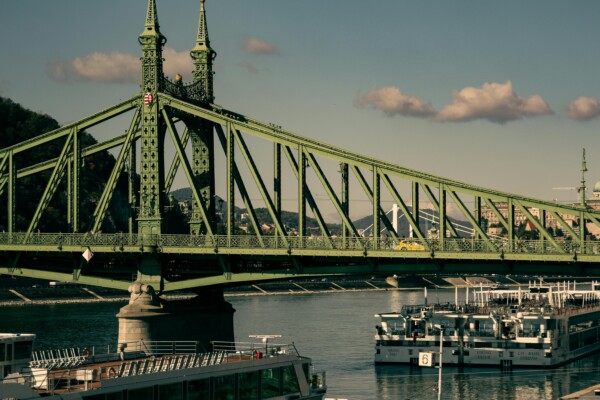
Liberty Bridge: The Green Favorite
Liberty Bridge is perhaps the most beloved structure by the locals. It was built for the 1896 Millennium Exhibition in Hungary. Emperor Franz Joseph himself hammered the last silver rivet into place. The bridge was originally named after the famous Austrian Emperor. It has a beautiful Art Nouveau style with green steel. It looks like a delicate lace made of heavy metal pieces.
The top of the four masts features the mythical Turul bird. These birds are important symbols in ancient Hungarian mythology and legends. The bridge is relatively short compared to the other river crossings. This makes it very easy to walk across in five minutes. It is one of the most charming bridges in Budapest today.
In recent years, the bridge became a popular summer hangout spot. The city often closes it to car traffic on weekends. People bring hammocks, yoga mats, and drinks to the warm steel. You can sit on the railings and watch the sunset. It is a unique community space for the young generations.
Location: Between Fővám Square and Szent Gellért Square
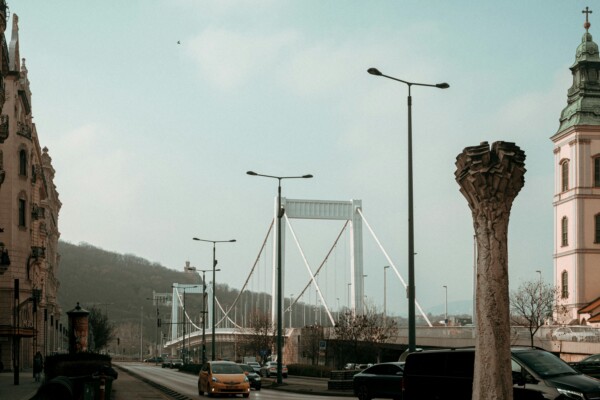
Elizabeth Bridge: The White Grace
The original Elizabeth Bridge was a miracle of 19th-century engineering. It was once the largest suspension bridge in the entire world. It was named after Queen Elisabeth, the famous wife of Franz Joseph. Hungarians loved her deeply and called her by her nickname, Sisi. Unfortunately, the original decorative bridge was destroyed in the Great War.
The new bridge was built in a very modern, minimalist style. It opened in 1964 with a bright white cable-stayed design. It looks very light and elegant against the green Buda hills. The bridge connects the busy shopping streets with the Gellért Hill. It is one of the most photographed bridges in Budapest at night. The special floodlights make it glow like a white ribbon.
You can find a statue of Queen Elisabeth near the Buda end. The park around the statue is a very peaceful place. Many people walk here after visiting the nearby Rudas Thermal Bath. It is the only bridge that was not rebuilt originally. This modern look makes it stand out from the older structures.
Location: Between Március 15. Square and the foot of Gellért Hill
Petőfi Bridge: The Link to Universities
Petőfi Bridge was built in the 1930s to help the growing city. It was named after the famous revolutionary poet, Sándor Petőfi. The bridge has a very simple and functional industrial design. It is not as decorative as the older historic river crossings. However, it plays a vital role in the daily city life.
The bridge connects the southern part of the Grand Boulevard. Many large universities are located near both ends of the bridge. Because of this, thousands of students cross it every single day. You can find many popular outdoor clubs near the Pest side. It is one of the busiest bridges in Budapest for tram traffic. The famous tram lines 4 and 6 cross here constantly.
You can see the modern buildings of the Infopark from here. The view towards the south shows the developing part of Budapest. It is a great place to see the modern face of Hungary.
Location: Connects Boráros Square with the university campus in Buda
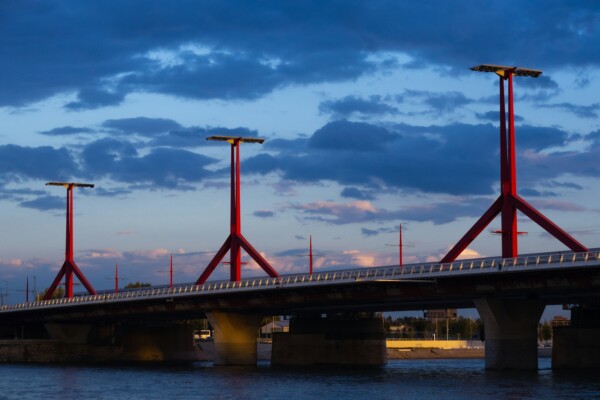
Rákóczi Bridge: The Modern Gateway
Rákóczi Bridge is the second newest bridge in the Hungarian capital. It was completed in 1995 to relieve the heavy city traffic. Originally, it was named after the district called Lágymányos in Buda. Later, it was renamed to honor the noble Rákóczi family. The bridge has a very distinctive look with five red towers. These towers have special mirrors to reflect the light downwards.
This bridge is located next to a major railway crossing. You can see the huge red National Theatre from its path. The Palace of Arts is also standing right next to it. It is one of the most artistic bridges in Budapest today. The area around it has become a cultural hub recently.
You can take a walk here to see the new architecture. The bridge has wide paths for both pedestrians and fast cyclists. It offers a great view of the new Kopaszi Dam park.
Location: Southern Budapest, near the National Theatre
Árpád Bridge: The Longest Crossing
Árpád Bridge is the longest bridge in the city of Budapest. It was named after the leader of the first Hungarian tribes. The construction began before the war but stopped for many years. It was finally finished in 1950 during the communist era. The bridge is almost one kilometer long and very wide.
It connects the northern parts of the city with Buda. This bridge also has an exit to the northern tip of Margaret Island. You can also reach the historic Óbuda district from here. It is one of the most important bridges in Budapest for commuters. Thousands of cars and buses use it to reach their work.
The bridge is not as romantic as the Chain Bridge nearby. However, it offers a great view of the rolling Buda mountains. You can see the ruins of the Roman city nearby.
Location: Northern Budapest, connects Váci út with Óbuda
Walking across these structures is the best way to see Budapest. You can feel the history under your feet on every step. Each bridge offers a new angle of the beautiful river Danube. You will never forget the lights reflecting on the dark water. These seven bridges are the true crown of our capital city.
Would you like to see these sights with a professional guide? Check out our Private Tour Around Budapest at aroundbudapest.com for a tailor-made experience!